In today’s enterprise landscape, digital transformation is no longer a distant goal but a necessary strategic pursuit. Organizations that want to stay competitive and relevant must adopt structured approaches to guide their transformation journeys effectively. A Digital Transformation Framework serves as a unified architecture that aligns strategy, operations, technology, and human adoption across the entire organization. It helps leaders translate high-level vision into actionable, measurable outcomes that drive value.
Unlike isolated digitization projects or one-off technology initiatives, a true transformation reshapes how an organization operates, delivers value, and competes in its market. It involves integration across multiple domains, including data, infrastructure, process, and culture. Without a coherent framework, these efforts can easily become fragmented, resulting in wasted investment, poor adoption, and internal misalignment. This article provides an in-depth exploration of the essential components of a Digital Transformation Framework, outlining how each contributes to achieving sustainable, enterprise-scale success.
Every successful transformation begins with strategic alignment. At its core, a Digital Transformation Framework must link transformation initiatives directly to the organization’s strategic objectives. These objectives should not only describe what the organization wants to achieve but also define how digital capabilities will create measurable business value. Clear articulation of the transformation vision enables leaders to align technology investments with key objectives, including revenue growth, operational efficiency, customer satisfaction, and market expansion.
Organizations can use Business Capability Modeling to translate strategic goals into tangible capabilities. For instance, if a company wants to improve its supply chain agility, the framework should map the necessary capabilities such as real-time data visibility, supplier integration, and predictive analytics. This approach ensures that transformation initiatives are prioritized based on their business impact, rather than purely on technical convenience.
Strategic alignment depends heavily on leadership commitment. A framework should explicitly outline governance models that ensure sponsorship and accountability. Executive steering committees, digital strategy boards, and cross-functional councils are common governance mechanisms that maintain alignment between strategy and execution.
A well-structured governance model includes three key layers:
When leadership demonstrates consistent sponsorship, it reinforces the importance of transformation across departments and mitigates resistance to change.
Digital transformation is rarely a single project. It is a portfolio of initiatives that together deliver cumulative business value. The framework should include a portfolio management function that evaluates, prioritizes, and tracks initiatives based on their strategic contribution. This approach prevents redundant efforts and encourages the reuse of technologies, data models, and processes, thereby promoting efficiency and effectiveness.
Portfolio-level visibility allows leadership to make informed trade-offs between innovation speed and operational stability. Tracking metrics such as value realization rate, technical debt accumulation, and capability maturity provides transparency and discipline throughout the transformation lifecycle.

Customer-centricity lies at the heart of every effective Digital Transformation Framework. The transformation must begin with a deep understanding of customer needs, behaviors, and expectations, often captured through digital tools that enhance employee and customer engagement. Journey mapping techniques help identify customer pain points and design solutions that reduce friction while improving satisfaction.
Organizations can embed the Voice of the Customer (VOC) into their framework through mechanisms such as Net Promoter Score (NPS), Customer Satisfaction Score (CSAT), and real-time feedback loops. These metrics inform design and prioritization decisions, ensuring that new capabilities are aligned with actual customer demand. The goal is not only to digitize touchpoints but to reimagine how customers interact with the business.
Customer-centric transformation extends into technology design. Experience-oriented architecture emphasizes flexibility, personalization, and consistency across all digital and physical channels. Omnichannel integration enables customers to transition seamlessly between web, mobile, and in-person experiences without losing context or continuity.
This layer of the framework typically includes personalization engines, adaptive UI frameworks, and API-driven service integration. When systems communicate effectively, organizations can deliver cohesive experiences and leverage real-time analytics to dynamically adapt content and offers. Experience architecture transforms customer engagement from reactive to proactive, allowing organizations to anticipate needs rather than simply respond to them.
Transforming technology without transforming processes leads to limited value. A mature Digital Transformation Framework includes process redesign as a core pillar. This goes beyond surface-level automation and aims to fundamentally rethink workflows for a digital-first environment. The goal is to eliminate friction, minimize manual effort, and establish systems that enable continuous improvement.
Techniques like process mining, simulation modeling, and Lean Six Sigma can help identify inefficiencies and opportunities for reengineering. The redesigned process should incorporate automation, analytics, and decision-making intelligence directly into workflows. This creates agile, responsive processes that improve both customer experience and operational efficiency.
Automation is a key enabler of scalability and precision. The framework must define how automation will be deployed across the enterprise in a coordinated way. A comprehensive automation ecosystem often includes:
Automation should not exist in silos. The Digital Transformation Framework must include orchestration mechanisms to ensure data, rules, and human decisions are connected across processes. Governance is equally critical; oversight mechanisms must monitor the performance of automation, exceptions, and the business value delivered.
A well-designed enterprise architecture is the structural foundation of any Digital Transformation Framework. It enables scalability, agility, and resilience by organizing systems into interoperable, modular components. Cloud-native infrastructure, microservices, and containerization technologies, such as Kubernetes, have become essential elements of modern digital ecosystems.
Event-driven architectures enable asynchronous communication between systems, improving responsiveness and fault tolerance. Meanwhile, an API-first design philosophy ensures that every system component can interact seamlessly with others through well-documented and secure interfaces. Together, these principles create an environment capable of continuous evolution without disruptive overhauls.
Most enterprises operate in hybrid IT environments that combine legacy on-premise systems with cloud-based applications. Achieving interoperability across these diverse platforms is a significant challenge that the Digital Transformation Framework must address.
Integration strategies typically leverage middleware, API gateways, and hybrid integration platforms (HIPs). These tools facilitate secure data exchange and synchronize business processes across systems. An effective integration architecture should include:
Integration is not only technical but also organizational. Successful frameworks promote standardized data contracts and shared governance to avoid duplication and inconsistency across teams.
Data is the core of modern business operations, and a Digital Transformation Framework must define how it will be collected, governed, and utilized. A unified data platform allows organizations to move from fragmented data silos to centralized, governed ecosystems. Key design principles include scalability, accessibility, and lineage tracking.
Organizations often adopt hybrid data architectures that combine data lakes for raw ingestion with data warehouses for structured analytics. Emerging lakehouse models unify both, supporting real-time and batch processing simultaneously. Proper data governance ensures data quality, ownership, and compliance with regulations such as the General Data Protection Regulation (GDPR).
Analytics must extend beyond static dashboards to become actionable intelligence. Operational analytics integrates insights into everyday workflows, enabling decision-making at every level. Predictive analytics, powered by machine learning, helps organizations anticipate outcomes and automate next-best actions.
DataOps methodologies apply DevOps principles to data management, emphasizing continuous integration, version control, and automated testing for data pipelines. This ensures that analytics models remain reliable, reproducible, and scalable as the business evolves.
For transformation efforts to succeed at scale, organizations must rethink their operating models. Traditional functional silos and waterfall delivery approaches often hinder agility and responsiveness. The Digital Transformation Framework should define a new delivery structure built around cross-functional, product-centric teams that own capabilities end-to-end.
Agile frameworks like the Scaled Agile Framework (SAFe), Large-Scale Scrum (LeSS), or Disciplined Agile Delivery (DAD) provide structured approaches for scaling agility across large enterprises. These methods often work in tandem with foundational change management models that guide individuals and teams through adaptation during organizational transformation.
These models encourage incremental delivery, continuous feedback, and alignment with customer value. Agile transformation is not merely about changing the software development process; it involves revisiting governance, budgeting, release planning, and metrics to ensure a comprehensive approach.
By shifting from project-based funding to product-based investment, organizations create durable teams focused on continuous improvement and capability development. These teams require empowerment, access to necessary data, and the ability to make localized decisions that align with the broader business strategy.
A successful transformation depends on equipping teams with the right roles and competencies. The Digital Transformation Framework should define the new skill sets required and the support structures needed to develop them. Key roles often include:
To embed transformation at scale, organizations must invest in developing their capabilities. Communities of practice, internal certification programs, and transformation centers of excellence play a crucial role in scaling knowledge, standardizing practices, and fostering cultural change.
Training alone is insufficient. Reinforcement mechanisms such as leadership modeling, reward systems, and embedded coaching are critical for sustaining new ways of working. Without these elements, organizations risk regression to legacy behaviors once initial excitement fades.
The Digital Transformation Framework must directly address user adoption. Technology deployment without corresponding user enablement results in underutilized tools and low returns on investment. Adoption efforts should focus on accelerating time-to-competency, increasing feature usage, and reducing friction in daily workflows.
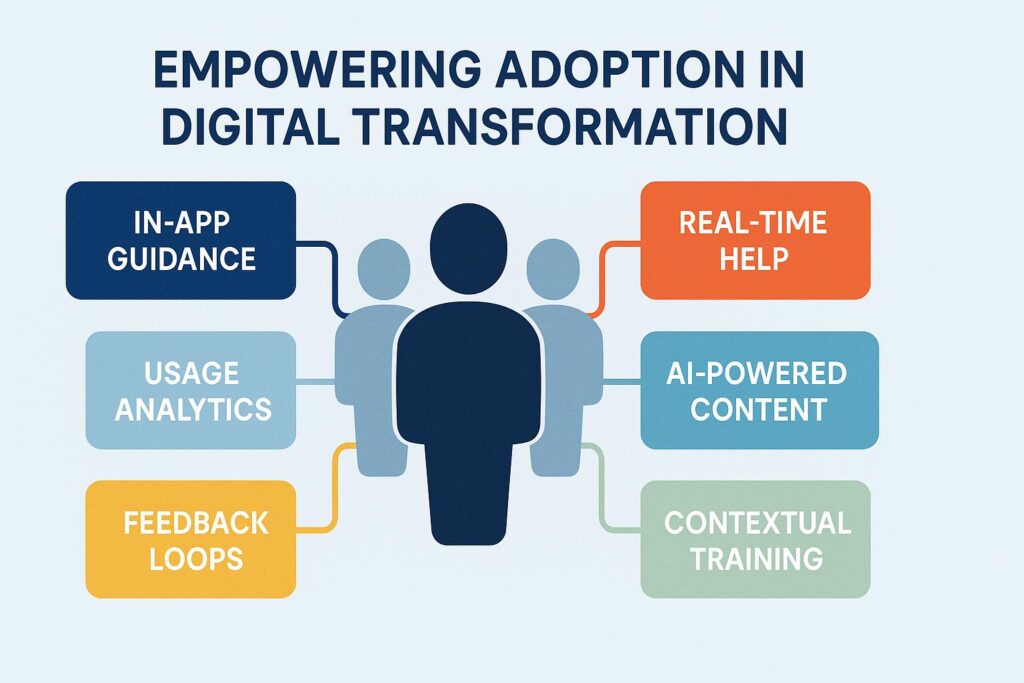
Real-time, contextual support embedded within enterprise applications is more effective than one-time classroom training or static manuals. Tools that provide in-application guidance, walkthroughs, and performance support ensure that users learn in the flow of work. This not only improves retention but also minimizes disruptions to productivity.
Digital adoption must be viewed as a continuous capability. As new features roll out, users must be supported through each stage of the change journey. This requires proactive planning and coordination between IT, HR, training, and line-of-business owners.
A data-driven approach to adoption is essential. Rather than relying on anecdotal feedback, organizations should define key adoption metrics and regularly monitor them to ensure effective implementation. These metrics may include:
Collecting this data enables organizations to identify areas of concern and adjust their support strategies accordingly. Feedback should be captured through surveys, in-app prompts, and behavioral analytics to ensure adoption programs remain relevant and effective.
Security is a non-negotiable requirement in modern digital environments. The Digital Transformation Framework must incorporate security architecture from the outset of the design process, rather than layering it on later. Secure-by-design principles include threat modeling, secure coding standards, identity management, and continuous security testing.
Zero Trust architecture has emerged as a preferred security model. It assumes that every user and system must be verified, regardless of location or device. Identity and Access Management (IAM), endpoint detection, and encrypted communication protocols form the backbone of Zero Trust implementation.
Embedding security controls into the CI/CD pipeline through DevSecOps practices enables continuous monitoring and rapid remediation of vulnerabilities, ensuring a secure development process. This shift-left approach reduces security risk, allowing development teams to move at speed without compromising safety.
Compliance with regulatory frameworks such as GDPR, HIPAA, and Sarbanes-Oxley must be integrated into transformation planning. Embedding a dedicated solution for change governance helps support this complex domain. Rather than treating compliance as a manual reporting burden, organizations should adopt automated compliance mechanisms to streamline their approach to compliance and reinforce policies through effective compliance training strategies.
These include:
Risk management should extend beyond technical vulnerabilities to encompass broader aspects of risk. Third-party integrations, data residency issues, and organizational change resistance also represent risks that require mitigation strategies. A comprehensive framework includes risk assessments, scenario planning, and documented controls across all layers of transformation.
Measurement is the engine of progress. A mature Digital Transformation Framework must define clear performance indicators aligned with strategic objectives. These metrics should span business outcomes, operational efficiency, user behavior, and technical health.
Examples of effective KPIs include:
A tiered scorecard approach helps link individual team efforts to broader transformation goals. For instance, agile teams may track feature cycle time and customer impact, while executives focus on realizing business value and achieving capability maturity.
Transformation is not static. Feedback loops must be built into the framework to enable continuous improvement. This includes mechanisms for capturing insights from users, operational data, and business results. Agile retrospectives, quarterly business reviews, and architectural checkpoints are all tools for learning and iteration.
Governance structures must support both accountability and adaptability. Transformational leadership should conduct regular reviews of initiative health, capability progress, and strategic alignment to ensure ongoing effectiveness. These reviews inform course corrections, reprioritization of investments, and refinement of delivery methods.
Effective governance also includes mechanisms for identifying and retiring obsolete initiatives, ensuring that focus remains on high-impact opportunities. This dynamic approach to governance enables transformation to remain relevant, responsive, and resilient in the face of change.
A strong Digital Transformation Framework enables clarity, execution, and adaptability. Organizations can use the following checklist to evaluate and enhance their framework:
A comprehensive self-assessment using these questions can reveal gaps and opportunities for accelerating digital maturity and capability development.
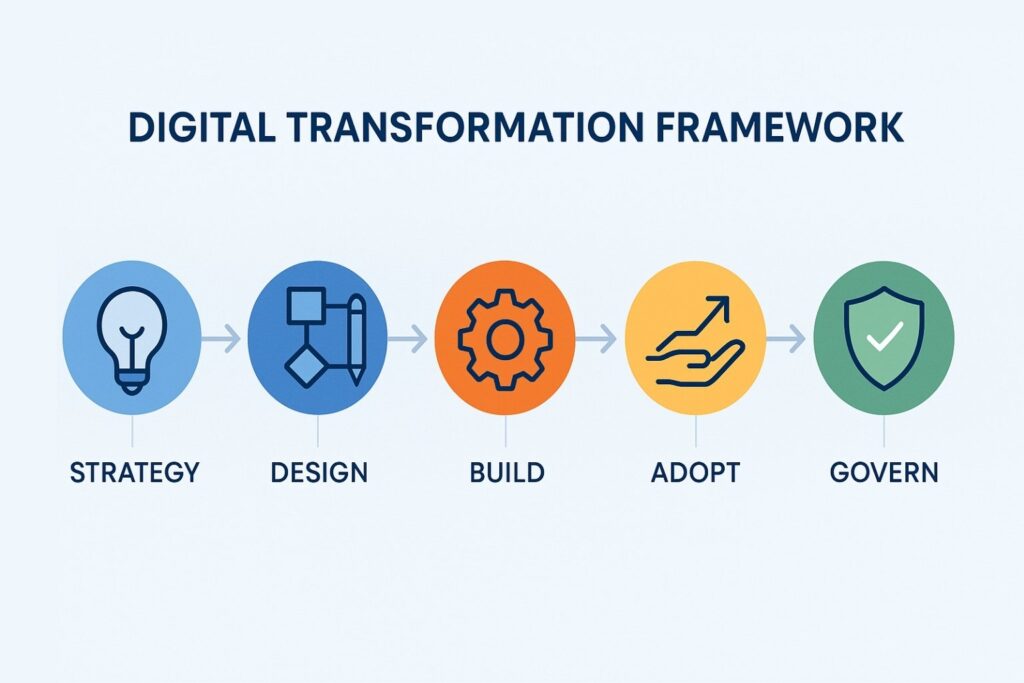
A well-structured Digital Transformation Framework is more than just a set of documents or templates. It is a living architecture that integrates vision, execution, technology, and culture into a cohesive whole. In complex enterprises, where scale, risk, and interdependencies are high, such a framework provides the discipline and direction necessary to manage transformation with confidence.
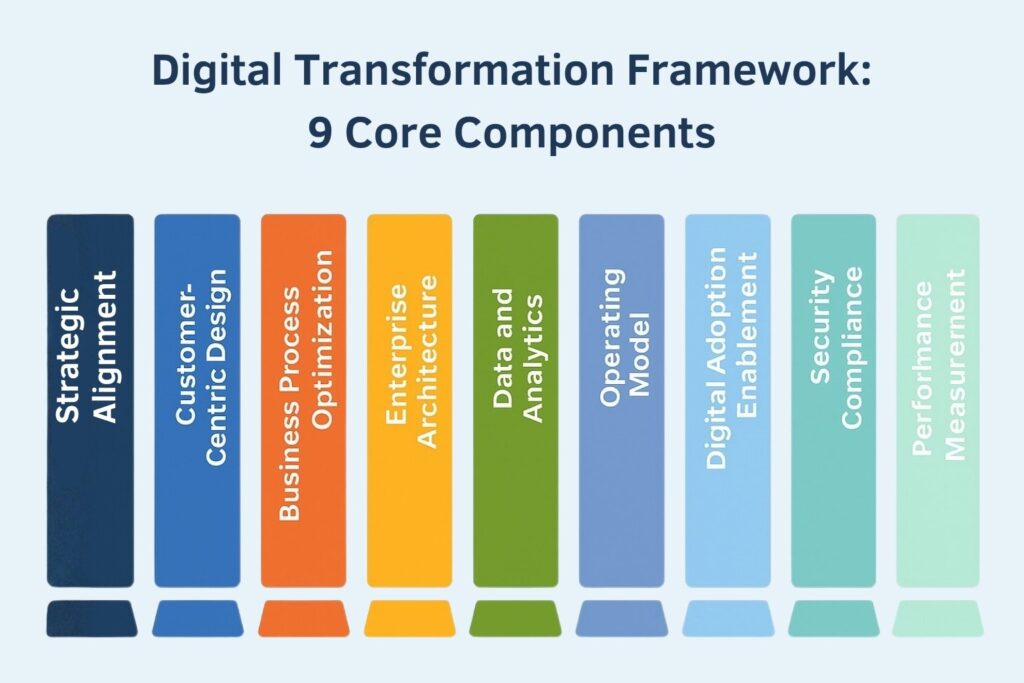
By organizing efforts across strategic alignment, customer experience, process improvement, architecture, data, adoption, security, and measurement, the framework transforms chaos into coordinated value delivery. Leaders who invest in building and maintaining such a framework position their organizations to not only respond to change but to lead it.
Transformation is not a destination. It is a continuous journey that requires structure, insight, and discipline at every turn. A Digital Transformation Framework ensures that this journey stays on course, delivers results, and builds the foundation for sustainable competitive advantage.
At VisualSP, we’ve built our platform to be the practical engine that drives [successful digital transformation](https://www.visualsp.com/products/digital-transformation/) and adoption across the enterprise. Everything covered in this article, from aligning strategy with execution to ensuring adoption at scale, depends on whether your users can successfully engage with the tools and systems provided to them. That’s where we come in.
VisualSP integrates directly into your enterprise web applications, delivering real-time, in-context support exactly when and where users need it. Instead of relying on outdated documentation or disruptive training sessions, users receive walkthroughs, inline help, and embedded videos right within their workflow. This leads to faster onboarding, fewer errors, and greater confidence using digital tools across the organization.
What sets us apart is our AI-powered content creation capability. Teams can rapidly generate support materials such as guides, step-by-step walkthroughs, and prompt templates using our AI assistant. This feature accelerates time to value and drastically reduces the manual effort required to enable users effectively.
With pre-built content, a transparent and scalable pricing model, and support for over 2 million users across industries, VisualSP is the trusted digital adoption platform for organizations seeking real results. Whether your organization is rolling out a new CRM, evolving internal processes, or scaling AI across teams, we ensure users stay supported and productive from day one.
If your transformation strategy depends on real user adoption, it's time to put VisualSP at the center of your enablement layer.
Get started today and see how VisualSP can help you maximize your digital transformation efforts.
Fuel Employee Success

VisualSP accelerates digital adoption, digital transformation & user training.

Stop Pissing Off Your Software Users! There's a Better Way...
VisualSP makes in-app guidance simple.

