Over the past two years, the conversation about enterprise artificial intelligence has shifted from hype into practical strategy. In my advisory work with organizations pursuing digital transformation and AI adoption, two platforms dominate the conversation: Microsoft Copilot and Salesforce Agentforce. Both represent cutting-edge approaches to embedding AI into enterprise environments, but they serve distinct purposes and are built on different foundational philosophies.
When decision-makers ask me about Microsoft Copilot vs Salesforce Agentforce, they are usually seeking guidance beyond technical specifications. They want to understand how each platform fits into their current infrastructure, whether it supports their governance framework, and how it might influence long-term organizational agility. The answer is never as simple as choosing “the better product.” It depends on architecture, integration capabilities, security requirements, and the kind of workflows the organization prioritizes.
This article is intended to give an in-depth, expert comparison of these two platforms. The analysis will address their strategic positioning, architecture, data governance, agent automation, integration ecosystems, automation capabilities, contextual reasoning, monitoring controls, performance considerations, adoption factors, and a final decision framework. The goal is to equip leaders with the insight needed to make a deliberate, future-proof choice.
Microsoft Copilot is positioned as an AI layer integrated directly into Microsoft 365 and Dynamics 365. It is not marketed as a separate platform but rather as a built-in augmentation to applications such as Word, Excel, PowerPoint, Outlook, and Teams. This approach reduces user friction by embedding AI into familiar interfaces, allowing employees to take advantage of intelligent features without leaving their primary workspace. Integration with Microsoft Graph provides access to a wide range of contextual enterprise data, including calendars, documents, emails, and application records.
The strategic aim is horizontal coverage, meaning Copilot is intended to enhance a broad set of workflows across multiple departments and disciplines. This makes it suitable for organizations where knowledge work spans varied functions and collaboration patterns. Its biggest advantage lies in its ability to support multiple business units without requiring separate AI products or significant workflow changes.
Salesforce Agentforce occupies a different position, serving as the AI engine within the Salesforce Customer 360 ecosystem. Its focus is vertical, targeting customer-facing processes such as sales, service, marketing, and commerce. Agentforce is designed to automate and optimize tasks that directly impact the customer lifecycle, drawing heavily on data from Salesforce’s CRM foundation. By leveraging unified customer profiles, it can initiate proactive engagement, provide real-time recommendations, and execute multi-step workflows.
This specialization makes Agentforce particularly valuable in industries where customer interaction is central to business performance. The platform’s extensive integration with CRM data means its AI-driven decisions are grounded in rich, real-time context, improving both personalization and operational efficiency. For companies whose core value is delivered through direct customer engagement, Agentforce offers a domain-optimized AI capability that general-purpose assistants cannot match.

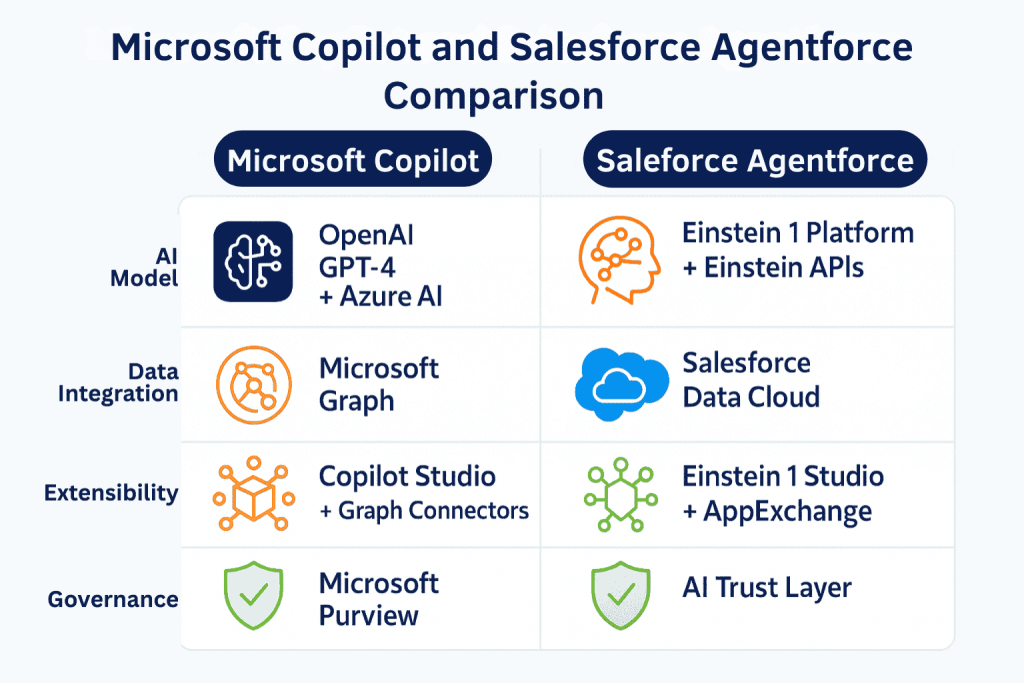
Microsoft Copilot uses large language models from OpenAI alongside Microsoft’s own Azure AI capabilities. The orchestration layer is powered by Microsoft Graph, which aggregates structured and unstructured data across the Microsoft ecosystem. This architecture benefits from Azure’s scalability, geographic redundancy, and compliance certifications such as ISO 27001, SOC 2, and GDPR alignment.
Copilot is optimized for seamless operation within Microsoft-native environments. While it can integrate with non-Microsoft sources via Graph Connectors, these integrations often have less contextual depth than native ones. This limitation should be considered by organizations that rely heavily on third-party platforms for mission-critical workflows.
Agentforce is built on and powered by the Einstein 1 Platform, Salesforce’s unified AI, data, and CRM foundation, which supports Salesforce’s proprietary AI models and can connect to external large language models through APIs. Leveraging this foundation, Agentforce adds its own Atlas Reasoning Engine and autonomous agent capabilities. Its core data layer, Salesforce Data Cloud, ingests and unifies real-time data from CRM, ERP, marketing, commerce, and IoT systems, enabling personalized, context-rich automation.
This unified view allows Agentforce to deliver highly personalized interactions based on the most current customer information. It is designed for scenarios where immediate access to accurate customer data can influence the quality and timing of interactions. The architecture prioritizes real-time decision-making and workflow execution within the Salesforce environment.
Copilot accesses enterprise data via Microsoft Graph, aggregating content from SharePoint, OneDrive, Exchange Online, Teams, and Dynamics 365. Governance is enforced through Microsoft Purview, enabling consistent application of classification, retention, and sensitivity labels across AI-assisted tasks.
This model ensures that compliance requirements extend into AI usage, reducing the risk of data leakage or misuse. However, Copilot’s governance capabilities are most effective when the bulk of organizational data resides within the Microsoft ecosystem. Integrating non-Microsoft data into this governance framework is possible but often requires additional customization.
Agentforce relies on Salesforce Data Cloud to create a unified, real-time view of each customer. Through identity resolution, it merges duplicate records and reconciles fragmented datasets, ensuring the AI operates on accurate information.
This approach is highly effective for managing customer data, especially in organizations with complex, multi-channel customer interactions. The governance framework, however, is optimized for customer-related data rather than broad enterprise information. Non-customer data management would require integration with external systems or additional governance tools.
Microsoft Copilot operates as a context-aware assistant embedded within each Microsoft 365 and Dynamics 365 application. The majority of its functions are triggered by user requests, which means tasks are generally scoped to the environment in which the user is working. For example, within Excel, Copilot can analyze datasets, apply transformations, generate pivot tables, and perform statistical forecasts without switching applications. Cross-application workflows can be achieved by connecting Copilot to Power Automate or the Power Platform, enabling a sequence of AI-driven actions that span multiple tools. This controlled execution model ensures predictable behavior and reduces the likelihood of unintended automation outcomes, which is a valuable feature in highly regulated industries.
Salesforce Agentforce agents are designed for a higher level of self-direction within the Salesforce ecosystem. They can operate across multiple clouds, such as Sales Cloud, Service Cloud, and Marketing Cloud, executing workflows without requiring constant human initiation. A single Agentforce agent can receive a customer case, check entitlements against records in an ERP system, schedule a service appointment, send a confirmation email, and initiate follow-up tasks. These workflows can be fully automated or set to require human approval at certain decision points. The platform’s built-in governance and escalation rules ensure that even self-directed processes maintain compliance and oversight.
Microsoft provides extensibility through Copilot Studio, which allows organizations to build custom copilots, create domain-specific prompts, and connect to proprietary datasets. Integrations are further supported by Microsoft Graph APIs and the Power Platform, making it possible to embed Copilot’s capabilities into highly specific business processes. This flexibility allows enterprises to adapt Copilot to industry-specific requirements, from legal contract review to supply chain analytics. However, such customization typically requires dedicated development resources and governance frameworks to ensure that AI-generated outputs comply with internal and external regulations.
Built on the Einstein 1 Platform, Agentforce supports extensibility through tools such as Agent Builder, Flow Orchestration, and the AppExchange. AppExchange offers thousands of prebuilt integrations and industry-specific apps, allowing rapid adaptation to vertical use cases without extensive in-house development. Organizations can also integrate systems such as electronic health records into Salesforce Data Cloud for AI-driven engagement, with compliance guardrails provided by the Einstein Trust Layer.
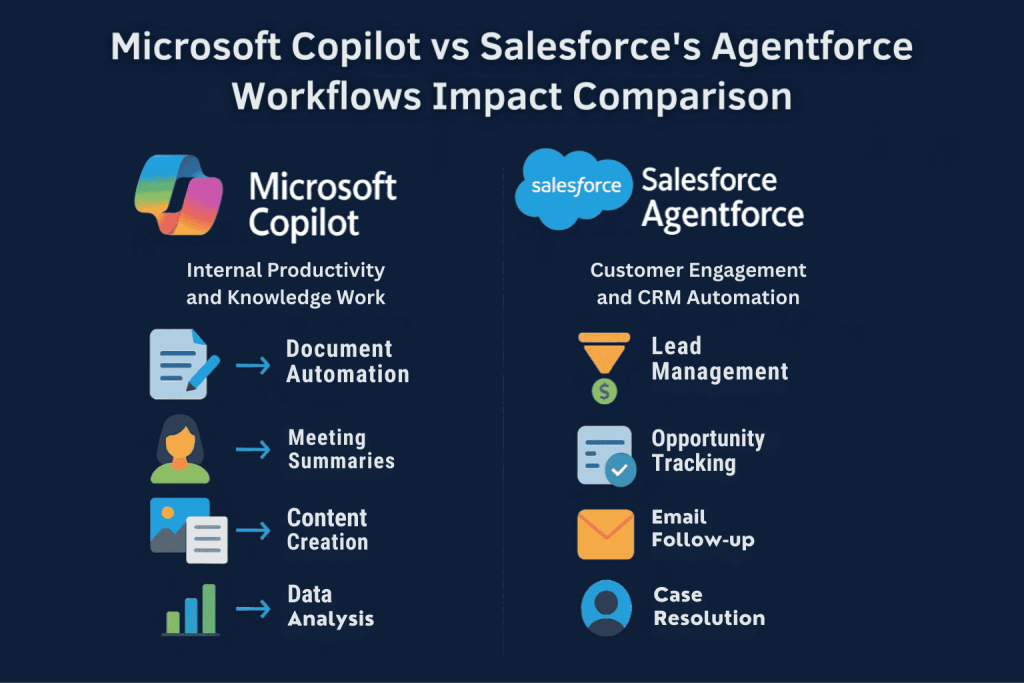
Microsoft Copilot is particularly effective at streamlining internal productivity workflows that rely heavily on document creation, analysis, and collaboration. Within Word, it can draft proposals based on previous project documents and meeting notes. In Excel, it can analyze datasets, generate pivot tables, and produce forecasts with minimal manual intervention. Its integration with Microsoft Graph allows it to draw on context from across the organization, ensuring that automated outputs are not only accurate but also contextually relevant. This makes Copilot a strong choice for knowledge workers, project managers, and administrative teams seeking to cut down repetitive work and focus on higher-value activities.
Salesforce Agentforce excels at orchestrating complex, customer-facing workflows that span multiple systems and interaction channels. In a sales context, it can qualify leads, trigger personalized marketing campaigns, and schedule follow-ups without human intervention. In service operations, it can handle case triage, route inquiries to the appropriate department, and even resolve routine issues autonomously. By leveraging Salesforce Data Cloud for real-time customer insights, Agentforce ensures that every automated action is informed by the latest available data. This capability reduces service delays, improves customer satisfaction, and frees up human agents to focus on complex or high-value customer interactions.
Microsoft Copilot uses contextual embeddings from Microsoft Graph to understand and connect information across the enterprise. For example, when asked to prepare a project status report, it can reference relevant Teams meetings, Outlook threads, and SharePoint files to compile an accurate, up-to-date summary. This continuity of context reduces the need for users to manually gather inputs from multiple sources. The model’s ability to synthesize diverse content types makes it suitable for multi-phase projects where information is scattered across different formats and systems. This approach improves efficiency in environments where collaboration and information sharing are critical to outcomes.
Agentforce leverages domain-specific AI models and prebuilt industry templates to tailor its capabilities to verticals such as financial services, healthcare, and manufacturing. These models incorporate specialized vocabulary, compliance requirements, and customer lifecycle patterns unique to each sector. As a result, Agentforce can interpret industry-specific requests more accurately and execute processes in a way that aligns with regulatory and operational norms. This domain adaptation accelerates deployment by reducing the need for extensive customization. It also enhances accuracy and trust in AI outputs, particularly in sectors where compliance and precision are paramount.
Microsoft Copilot integrates seamlessly with existing enterprise compliance frameworks through features like audit logging and data loss prevention (DLP) policies. These controls provide administrators with visibility into AI-generated actions and allow them to enforce strict data handling policies. By aligning with existing governance systems, Copilot ensures that AI usage adheres to the same security and compliance standards as other enterprise tools. This is particularly important for regulated industries that must demonstrate full accountability for how data is accessed and used.
Agentforce employs the Salesforce AI Trust Layer to maintain data security and compliance throughout AI-driven workflows. This framework can anonymize sensitive information before sending it to third-party models, perform real-time compliance checks, and maintain audit trails for all AI decisions. These features are vital for organizations handling large volumes of personally identifiable information or sensitive transaction data. The Trust Layer helps ensure that even in isolated use cases, Agentforce remains compliant with both internal governance policies and external regulatory requirements.
Microsoft Copilot benefits from its execution within the same cloud environment as Microsoft 365, allowing it to deliver low-latency performance for in-application tasks. Actions like generating documents, analyzing spreadsheets, and summarizing meeting notes occur with minimal delay because they do not require cross-environment calls. However, when workflows require integration with third-party systems outside the Microsoft ecosystem, performance may depend on the efficiency of Graph Connector configurations. This makes Copilot especially strong in Microsoft-centric environments where most data and processes reside within native systems.
Agentforce demonstrates its strongest performance when orchestrating workflows within the Salesforce Customer 360 environment. By processing real-time data through Salesforce Data Cloud, it can execute multi-step tasks involving CRM, ERP, and marketing systems with minimal lag. This capability is particularly valuable in customer engagement scenarios where timely responses directly influence satisfaction and retention rates. In environments where Salesforce is the system of record, Agentforce can operate as the central nervous system for customer interactions, ensuring that no opportunity or service request is delayed.
Microsoft Copilot often has a smoother adoption path in organizations already standardized on Microsoft 365. Its integration into familiar tools like Word, Excel, and Teams means employees can experiment with AI features without extensive retraining. This gradual exposure helps build trust in AI-assisted workflows and encourages adoption through incremental value delivery. The platform’s assistive nature, where users retain control over final decisions, also supports cultural acceptance in organizations cautious about automation. This makes Copilot a good fit for enterprises introducing AI capabilities in a phased approach.
Agentforce typically requires a more deliberate change management strategy, especially when implementing autonomous workflows that replace manual processes. Adoption may involve process redesign, cross-departmental training, and the establishment of governance protocols to oversee agent behavior. However, when executed well, these efforts can yield significant improvements in efficiency, customer satisfaction, and operational scalability. For organizations ready to embrace high levels of automation in customer engagement, Agentforce can deliver transformative results in a relatively short time frame.
| Platform | Strengths | Weaknesses |
|---|---|---|
| Microsoft Copilot | - Broad applicability across diverse workflows
- Seamless integration with Microsoft 365 and Dynamics 365 - Strong compliance and governance capabilities |
- Limited contextual depth with non-Microsoft systems
- Less domain specialization compared to vertical solutions |
| Salesforce Agentforce | - Exceptional CRM integration and customer lifecycle automation
- Real-time data unification via Salesforce Data Cloud - Industry-specific AI models and templates |
- Narrower applicability outside customer engagement
- Dependent on high-quality, unified customer data for maximum effectiveness |
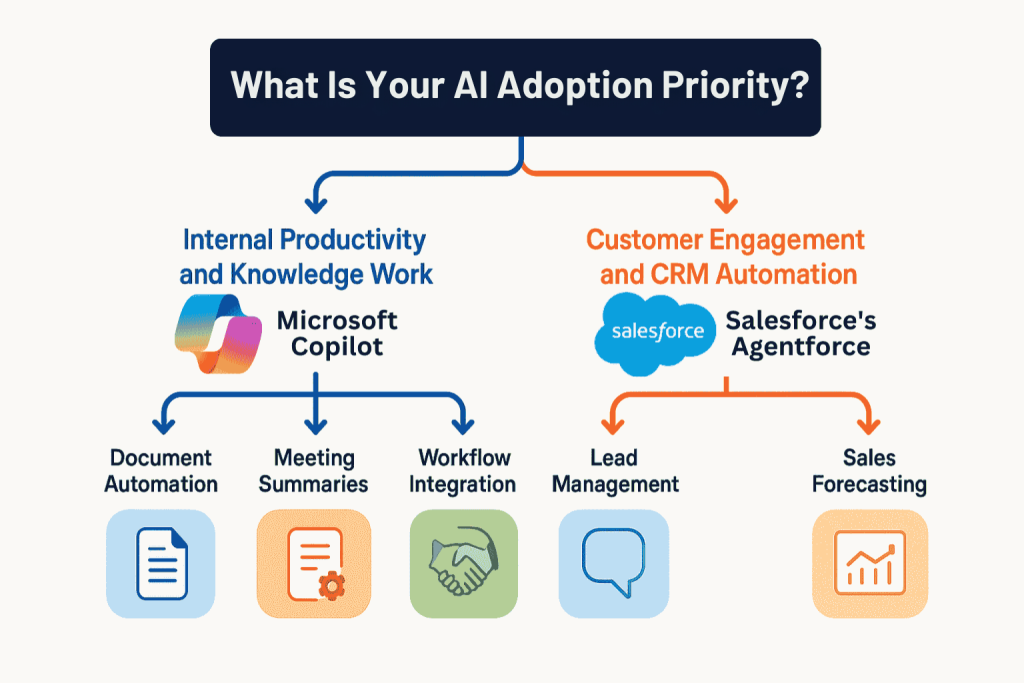
Microsoft Copilot is best suited for organizations whose primary challenge lies in internal productivity, collaboration, and information management. Its embedded AI capabilities within familiar Microsoft 365 applications make it a natural fit for enterprises already operating in Microsoft-centric environments. The platform delivers value incrementally, allowing users to adopt features at their own pace, which helps ease the cultural transition to AI-powered work. Copilot’s assistive approach, where the user maintains control over final outputs, also aligns well with governance requirements in risk-averse industries.
It is an especially strong choice for enterprises with distributed teams, complex document workflows, or cross-departmental projects that require tight integration across productivity tools. Organizations seeking a phased AI adoption strategy will find Copilot’s integration model conducive to steady, measurable gains without disruptive changes.
Salesforce Agentforce is the right choice for organizations that prioritize customer engagement, service efficiency, and revenue optimization. It excels in automating sales, marketing, and service processes that directly influence customer satisfaction and business performance. By leveraging real-time insights from Salesforce Data Cloud, Agentforce ensures that automated workflows are both timely and personalized.
This platform is particularly impactful in industries with high customer interaction volumes, such as retail, financial services, and telecommunications. For enterprises ready to redesign processes and embrace high levels of automation, Agentforce offers the potential for significant operational transformation. However, to unlock its full value, businesses should have a well-integrated, high-quality customer data foundation before implementation.
In the Microsoft Copilot vs Salesforce decision, there is no universal answer that fits every enterprise. Copilot serves as the AI assistant for internal knowledge work, while Agentforce is optimized for customer interaction workflows. The most successful organizations are those that match the platform’s strengths to their most urgent operational needs, ensuring AI becomes a strategic enabler rather than a disconnected tool.
From my perspective, the process should begin with a detailed assessment of your workflows, data architecture, and readiness for AI integration. Whether you choose Copilot, Agentforce, or both in a hybrid model, aligning the technology with your business strategy will determine its true value. AI is not just about automation; it is about transforming how value is delivered both inside the organization and to the customer.
When we work with organizations evaluating solutions like Microsoft Copilot or Salesforce Agentforce, we know that selecting the right technology is only part of the journey. The real challenge is ensuring that these AI tools are adopted effectively across the organization so they deliver measurable results. That is exactly where VisualSP makes a difference.
VisualSP integrates directly into enterprise applications, including platforms like Microsoft 365 and Salesforce, to provide in-context help, guidance, and communication. This allows users working with Copilot or Agentforce to access walkthroughs, inline help, and videos without leaving their current workflow. Our AI-powered content creation tools make it simple to create targeted support materials such as guided tours and prompt libraries, ensuring users understand and apply these AI capabilities from day one.
Our platform delivers contextual, real-time assistance that adapts to the user’s role and task. For example, a sales rep working in Agentforce can instantly access relevant tips, prompt templates, or compliance reminders, while an analyst using Microsoft Copilot in Microsoft Dynamics can receive embedded guidance for AI-powered analysis. This level of in-the-moment support accelerates adoption, reduces errors, and helps organizations capture the full ROI of their AI investment with VisualSP.
If your organization is ready to adopt AI tools like Microsoft Copilot or Salesforce Agentforce in a responsible and impactful way, we invite you to explore how VisualSP can help.
Fuel Employee Success

VisualSP accelerates digital adoption, digital transformation & user training.

Stop Pissing Off Your Software Users! There's a Better Way...
VisualSP makes in-app guidance simple.

