The enterprise technology landscape is moving at an unprecedented pace as artificial intelligence (AI) transitions from research labs to production environments. Organizations now consider AI-driven tools not just as experimental pilots but as integral components of digital transformation and operational excellence. Among the most prominent platforms leading this evolution are Microsoft Copilot and Google Gemini, both offering cutting-edge capabilities powered by large language models (LLMs).
This article delivers a detailed, expert-level comparison of Microsoft Copilot vs Gemini, focusing on their architecture, integration strategies, enterprise readiness, and long-term role in digital adoption initiatives. The goal is to equip technology leaders and practitioners with a rigorous framework for evaluating these tools within the broader context of AI adoption.
Over the past decade, enterprise AI has progressed from narrow, rule-based automation to highly capable systems based on LLMs. Early natural language interfaces required extensive configuration and offered limited flexibility. Today, advances such as OpenAI GPT models and Google DeepMind research have produced systems capable of reasoning across diverse inputs, including text, code, images, and video.
Organizations now expect AI to integrate seamlessly with productivity workflows, data repositories, and collaboration platforms. The shift has created demand for tools that combine raw model power with enterprise-grade security, compliance, and scalability.
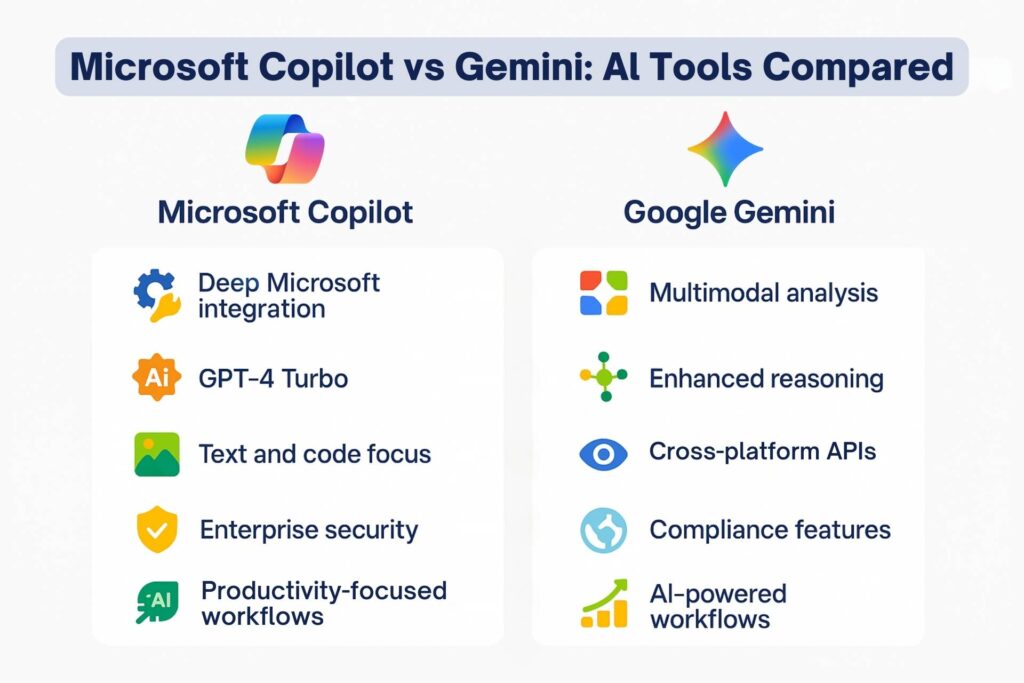
Microsoft has taken an ecosystem-first approach by embedding Copilot into familiar products. Rather than positioning AI as a standalone tool, the company integrates it directly into Microsoft 365, GitHub, Dynamics 365, and the Power Platform. By coupling GPT-5 with Microsoft Graph, Copilot leverages organizational context to deliver personalized assistance across writing, analysis, meetings, and data-driven tasks.
This strategy aligns with enterprise needs for minimal disruption and rapid adoption. Users engage with Copilot through interfaces they already understand, reducing friction and encouraging sustainable usage.
Google’s journey to Gemini reflects a research-heavy lineage, originating from the PaLM architecture and the Bard project. Gemini introduces multimodal reasoning, enhanced code understanding, and improved retrieval across structured and unstructured data. The platform integrates with Google Workspace and Vertex AI, extending its reach into both productivity and developer ecosystems.
This design emphasizes flexibility. Enterprises can deploy Gemini through Workspace add-ons, API endpoints, or custom apps, making it a strong option for organizations prioritizing advanced reasoning and cross-modal capabilities over deep integration with existing productivity software.

Microsoft Copilot operates as a service layer over the Microsoft 365 suite. It combines GPT-5 with the Microsoft Graph, a centralized API that aggregates information from email, documents, chat, calendars, and other Microsoft services. When a user prompts Copilot, the tool retrieves relevant organizational data via the Graph, applies LLM reasoning, and produces responses aligned with enterprise knowledge.
This architecture ensures that Copilot does not function as a general-purpose chatbot but as a context-aware assistant optimized for business workflows.
Copilot spans several product domains, each designed for specific audiences and tasks:
These deployment variants share a common architectural foundation while tailoring outputs to unique user contexts.
Security remains a primary concern for enterprises evaluating AI tools. Copilot addresses this through its reliance on the Azure OpenAI Service, which enforces strict tenant isolation and content moderation policies. The service meets global standards such as SOC 2, ISO/IEC 27001, and GDPR requirements.
Administrators gain granular control over data access and permissions. Additionally, auditing and logging mechanisms enable organizations to track interactions, ensuring compliance with internal governance frameworks and regulatory obligations.
Microsoft positions Copilot as more than a static assistant. Through the Microsoft Copilot Studio, developers and IT teams can create plugins or integrate third-party applications. This extensibility allows organizations to:
The combination of extensibility and tight product integration makes Copilot particularly attractive to enterprises with established Microsoft environments.
Google Gemini represents the synthesis of extensive research by DeepMind and Google Research. It evolved from earlier projects such as PaLM and Bard, with Gemini 1.5 being the most prominent release at the time of writing. At its core, Gemini leverages a multimodal architecture capable of processing text, code, images, audio, and video. This architecture enables it to reason across different formats, making it suitable for use cases that extend beyond text-based workflows.
Unlike single-purpose language models, Gemini incorporates advanced retrieval mechanisms and contextual embedding techniques. These allow it to combine large-scale reasoning with domain-specific knowledge, providing outputs that can be both precise and creative. The platform also benefits from Google’s expertise in distributed systems, ensuring that its performance scales to meet enterprise-grade demands without compromising latency or reliability.
One of Gemini’s most accessible entry points is through Google Workspace. The tool integrates directly into applications such as Docs, Sheets, Slides, Gmail, and Meet, enabling professionals to draft documents, analyze data, and create presentations with AI support. In Gmail, for example, Gemini can generate responses to complex email threads or summarize key points from lengthy conversations, improving communication efficiency.
For organizations already invested in Workspace, this integration provides a low-friction path to adoption. Employees remain in familiar interfaces, while administrators manage AI settings through centralized Workspace controls. Gemini also respects Google’s enterprise-grade security and compliance practices, inheriting capabilities like encryption in transit and at rest, access auditing, and data loss prevention.
Beyond productivity applications, Gemini extends its reach via Vertex AI, Google’s managed machine learning platform. Enterprises and developers can interact with Gemini through APIs, integrate it with proprietary datasets, and even fine-tune models for specific domains. This makes Gemini particularly appealing to teams seeking to embed AI reasoning into custom workflows or vertical applications.
Vertex AI provides a suite of tools for lifecycle management, including dataset labeling, model evaluation, and monitoring. Combined with Gemini’s multimodal capacity, these features enable organizations to build robust solutions for areas such as customer support, knowledge retrieval, and multimedia content analysis.
Gemini’s design reflects a focus on versatility and research-driven innovation. Its key strengths include:
These attributes make Gemini a strong candidate for enterprises that require a balance of general-purpose support and domain-specific intelligence.
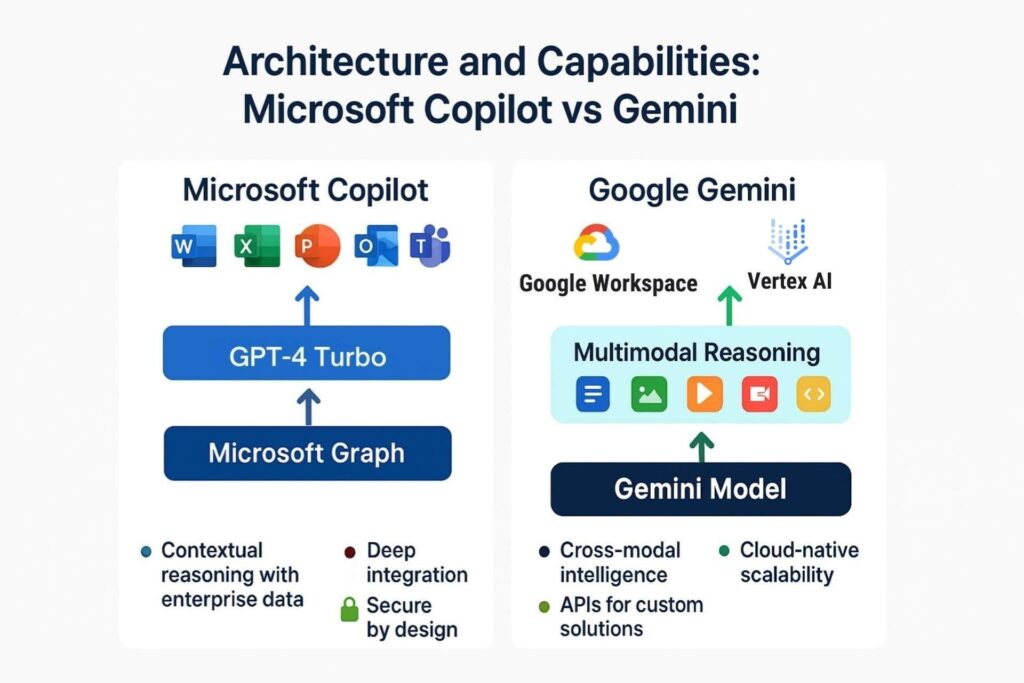
When evaluating Microsoft Copilot vs Gemini on their core language reasoning abilities, both platforms deliver high-quality outputs for drafting, summarization, and analysis. Copilot leverages GPT-5’s refined reasoning and benefits from context retrieved through Microsoft Graph. Gemini, on the other hand, excels in cross-modal reasoning and performs well in scenarios requiring the synthesis of diverse information types, such as interpreting text alongside diagrams or multimedia.
Copilot’s greatest strength lies in its deep grounding within Microsoft ecosystems. By connecting directly to content from SharePoint, OneDrive, and Teams, it ensures outputs reflect current organizational knowledge. Gemini approaches grounding differently, combining retrieval-based techniques with data indexed in Workspace or custom sources configured through Vertex AI. This makes Gemini more flexible but may require additional integration work for enterprises with complex data environments.
A defining distinction emerges in multimodality. Copilot primarily focuses on text and code, although Microsoft is expanding its capabilities to include images and data visualization. Gemini natively supports images, audio, and video, giving it an edge in tasks such as interpreting charts, explaining visual workflows, or analyzing recorded meetings.
Integration is where Copilot holds an advantage for Microsoft-centric enterprises. Its tight coupling with Office applications, Dynamics 365, and the Power Platform provides a unified experience. Gemini offers a more open ecosystem through Workspace, Google Cloud, and APIs, making it attractive for organizations with hybrid or custom technology stacks.
Both tools implement enterprise-grade controls, including access permissions, logging, and compliance certifications. Copilot benefits from Microsoft’s long-standing reputation in enterprise security and inherits Azure’s regulatory portfolio. Gemini leverages Google’s mature security model and provides transparency over data handling, but some enterprises may prefer the governance maturity of Microsoft’s platform if they operate in highly regulated sectors.
Evaluating Microsoft Copilot vs Gemini on latency reveals two distinct design philosophies. Copilot operates within the Microsoft 365 environment and uses the Microsoft Graph to gather contextual data before generating outputs. This extra step adds slight overhead, but Microsoft optimizes latency through its Azure OpenAI infrastructure, ensuring most responses appear in under two seconds for typical enterprise tasks.
Gemini, particularly when accessed through Google Workspace, benefits from Google’s extensive global network and optimized inference pipelines. Its responsiveness is comparable, often faster for tasks that do not require extensive data retrieval. When accessed via Vertex AI or APIs, performance depends on configuration and data volume, but organizations can leverage autoscaling features to maintain low latency even for complex workloads.
Accuracy in enterprise AI extends beyond grammatical precision; it encompasses relevance, factual grounding, and the ability to respect organizational context. Copilot excels at tailoring content to enterprise knowledge because it draws directly from user data stored in Microsoft services. Its success depends heavily on the quality and organization of the underlying content within SharePoint, OneDrive, and Teams.
Gemini’s strength lies in reasoning across diverse input types and synthesizing information with minimal hallucination. Its multimodal capabilities make it highly accurate when the task requires cross-referencing diagrams, tables, or multimedia assets. However, its outputs rely on careful prompt engineering or custom connectors to ground responses in proprietary information.
Both platforms deliver strong scalability, but they approach it differently. Copilot benefits from Microsoft’s mature tenant management, making it straightforward to roll out across thousands of users. Licensing models tie closely to Microsoft 365 subscriptions, which simplifies administration in organizations already standardized on Microsoft infrastructure.
Gemini scales effectively through Google Cloud’s architecture, allowing enterprises to run high-volume inference tasks and build domain-specific solutions. Vertex AI provides robust monitoring and autoscaling, making it well-suited to projects that involve fluctuating workloads or require horizontal expansion.
Reliability is essential for mission-critical use cases. Microsoft offers service-level agreements (SLAs) for Copilot as part of its Microsoft 365 umbrella, which includes guaranteed uptime and priority support for enterprise customers. Google delivers comparable SLAs for Workspace and Vertex AI, with extensive documentation on failover procedures and disaster recovery.
Both vendors continuously update their models, which requires enterprises to adopt robust testing strategies to monitor changes in behavior and maintain consistent quality over time.
Enterprises evaluating the Microsoft Copilot vs. Gemini must consider infrastructure readiness before adoption. Copilot requires Microsoft 365 licensing and permission configuration through the Microsoft 365 admin center. Organizations must also ensure data is properly organized and accessible via Microsoft Graph for Copilot to deliver relevant responses.
Gemini has fewer prerequisites when deployed via Google Workspace, but advanced use cases involving Vertex AI require technical expertise in API integration, identity management, and data pipeline orchestration. IT teams must plan for secure authentication and governance over how Gemini interacts with internal datasets.
Technology adoption does not succeed without preparing employees for new workflows. Training and communication plans are essential to ensure staff understand how to use AI responsibly and effectively. For Copilot, organizations often benefit from phased rollouts that focus on specific departments, allowing teams to refine prompts and establish best practices before scaling to the entire workforce.
Gemini adoption follows a similar path, especially in environments where multimodal capabilities introduce new ways of working. Enterprises should invest in clear guidelines on data privacy, appropriate usage, and escalation paths for feedback or issue resolution.
Digital adoption platforms (DAPs) are essential for helping organizations capture the full value of their AI investments. By embedding contextual guidance, walkthroughs, and just-in-time support directly inside business applications, they allow employees to learn as they work rather than leaving their workflows for separate training materials.
In addition, digital adoption platforms deliver analytics on feature usage and engagement. These insights enable IT and change-management teams to track adoption rates, pinpoint friction points, and adjust training programs as needed. When rolling out tools such as Copilot or Gemini, pairing the technical deployment with a structured enablement layer ensures employees understand how to use AI responsibly and get the most from its capabilities.
Governance frameworks should accompany any deployment of AI assistants. Organizations must define policies around data access, content review, and acceptable use. Copilot integrates with Microsoft Purview for compliance monitoring and data classification, making it easier to align with existing governance strategies.
Gemini benefits from Google’s Responsible AI principles, offering transparency on model limitations and bias mitigation strategies. Vertex AI includes monitoring capabilities that allow administrators to track model performance and ensure responsible behavior over time.
Microsoft offers Copilot through several licensing models aligned with its core product families. Microsoft 365 Copilot is sold as an add-on subscription, typically priced per user per month in addition to existing Microsoft 365 plans. Pricing tiers vary depending on enterprise agreements, volume commitments, and inclusion of premium security or compliance features.
GitHub Copilot uses a separate subscription structure. It is available to individuals through a personal plan and to organizations via GitHub Enterprise, with discounts for large user bases. Dynamics 365 Copilot is bundled into various CRM and ERP modules, and its cost scales according to usage across sales, marketing, and service workloads.
Microsoft’s approach integrates AI charges into its broader licensing ecosystem, simplifying procurement for enterprises already embedded in Microsoft’s cloud stack. Organizations gain predictable costs and administrative efficiency, especially if they leverage Enterprise Agreements to consolidate subscriptions.
Gemini offers a dual licensing model that distinguishes between consumer-grade access and enterprise deployments. Within Google Workspace, Gemini is available as part of the Gemini for Workspace add-on. Pricing is user-based, allowing organizations to scale gradually. Advanced capabilities, such as longer context windows and multimodal reasoning, are available through the Gemini Advanced tier.
For businesses building custom solutions on Vertex AI, Gemini follows a usage-based model. Charges depend on the number of tokens processed, model size, and the level of service chosen. This elasticity appeals to organizations with variable workloads or experimental initiatives that do not require fixed per-seat licensing.
When comparing Microsoft Copilot vs Gemini, enterprises must evaluate the total cost of ownership (TCO) rather than headline pricing alone. TCO includes:
Organizations should align cost models with adoption strategies. For Microsoft-centric businesses, Copilot’s predictable subscription may offer better budgeting. Teams requiring heavy customization or fluctuating workloads might find Gemini’s consumption-based billing more efficient.
Security remains a core concern when adopting enterprise AI. Copilot leverages Microsoft’s Azure OpenAI Service, which enforces tenant isolation and encryption across data at rest and in transit. Enterprises can configure geographic data residency to comply with local regulations such as GDPR or HIPAA.
Gemini inherits Google’s security model, including data encryption, boundary controls, and compliance certifications like ISO/IEC 27001 and SOC 2. Vertex AI provides additional options for private network access and fine-grained access controls, ensuring sensitive data remains within organizational boundaries.
Copilot integrates with Microsoft Purview, enabling compliance officers to apply data classification labels, retention policies, and audit trails. These features support highly regulated industries such as finance or healthcare, where legal discovery and record retention are mandatory.
Gemini aligns with Google’s Responsible AI guidelines. It offers administrators visibility into data usage and model behavior, with Vertex AI providing real-time monitoring dashboards for model drift and bias detection.
Responsible AI practices are essential as organizations rely on AI-generated content for strategic decisions. Copilot includes content filtering and role-based access to prevent misuse or exposure of sensitive information. Microsoft publishes extensive documentation on data handling, ensuring enterprises can assess compliance risks before rollout.
Gemini similarly documents its ethical principles and publishes research on model interpretability. Its APIs support logging and reporting, allowing enterprises to audit outputs for fairness, explainability, and adherence to internal policies.
Deploying tools like Microsoft Copilot or Google Gemini should never occur in isolation from broader digital transformation objectives. Both solutions can act as catalysts for rethinking business processes, knowledge management, and collaboration models. Copilot aligns particularly well with organizations that have already standardized on Microsoft 365 and want to accelerate productivity improvements without altering core workflows.
Gemini integrates naturally with Google Workspace and Google Cloud environments, offering a research-oriented platform for teams that need to bridge structured and unstructured data. Its multimodal strengths position it for organizations focusing on customer experience, media workflows, or data-intensive innovation.
Adoption is not a byproduct of technology; it is the result of intentional design. Enterprises often underestimate the learning curve that comes with AI-powered assistants. A well-defined enablement strategy can make the difference between widespread engagement and sporadic use.
Digital adoption platforms (DAPs) provide interactive guidance, microlearning, and usage analytics directly inside business applications. They allow organizations to deliver just-in-time training, helping employees understand how to use tools like Microsoft Copilot or Google Gemini effectively within their daily workflows. By embedding support at the moment of need, DAPs can shorten ramp-up time, improve retention of best practices, and ensure the long-term success of AI initiatives.
Enterprises rarely start from a clean slate. Copilot’s strength lies in its deep integration with Microsoft 365, Power Platform, and Dynamics 365, making it ideal for businesses with established Microsoft ecosystems. Gemini offers more flexibility for organizations with mixed environments or heavy investment in custom solutions. Its APIs and Vertex AI integrations allow enterprises to embed AI reasoning into bespoke applications while maintaining centralized governance.
When comparing Microsoft Copilot vs Gemini, decision-makers should start with a clear understanding of enterprise priorities. Important factors include:
A structured pilot approach enables organizations to validate performance, measure ROI, and refine governance policies. For Copilot, early pilots may focus on knowledge workers creating reports or analyzing data in Excel. For Gemini, pilots might explore cross-modal reasoning or custom workflows built on Vertex AI.
Iterative rollouts reduce risk while allowing leaders to gather feedback and adapt usage guidelines as employees become familiar with AI-driven processes.
Governance is an ongoing commitment rather than a one-time exercise. Establish clear policies for prompt usage, data sharing, and escalation of AI-related issues. Include monitoring tools that track output quality and ensure compliance with security and ethical standards. Both Microsoft and Google provide administrative dashboards and APIs for usage analytics, making it easier to integrate oversight into enterprise IT practices.
The trajectory of enterprise AI suggests a convergence between large language models, robotic process automation (RPA), and low-code platforms. Copilot is expected to expand its capabilities through deeper integration with the Power Platform, enabling employees to orchestrate workflows directly through natural language. Gemini’s roadmap points toward agentic behaviors, where models not only generate content but also execute multi-step tasks across systems.
Multimodality will likely define the next phase of competition between Copilot and Gemini. Microsoft is investing in embedding image understanding and analytics features into Copilot, while Google is refining Gemini’s ability to synthesize real-time signals across media, structured data, and sensor inputs. These advancements will unlock new applications in fields such as design, engineering, and scientific research.
No matter how powerful AI tools become, they require effective adoption strategies and strong human-in-the-loop controls. Enterprises that combine technological investment with structured change management, ethical oversight, and continuous learning will achieve the greatest impact. Establishing clear guidance for employees, encouraging responsible experimentation, and maintaining oversight of outputs are essential for sustaining trust and maximizing value. Organizations that treat AI deployment as both a technical and cultural initiative will be best positioned to translate new capabilities into measurable productivity gains.
| Aspect | Microsoft Copilot | Google Gemini |
|---|---|---|
| Core Focus | Context-aware assistant embedded in Microsoft 365, GitHub, and Dynamics 365 | Multimodal reasoning across text, code, images, audio, and video |
| Architecture | GPT-5 + Microsoft Graph for enterprise context | Derived from PaLM/Bard; multimodal with advanced retrieval |
| Integration | Deeply integrated with Microsoft 365 apps, Power Platform, and Dynamics | Built into Google Workspace; extended via Vertex AI & APIs |
| Strengths | Seamless Microsoft ecosystem fit, governance maturity, turnkey adoption | Versatility, research lineage, and strong cross-modal intelligence |
| Security & Compliance | Azure OpenAI tenant isolation, Purview for governance | Google security model, Responsible AI, monitoring in Vertex AI |
| Pricing Model | Per-user add-on for Microsoft 365; separate GitHub/Dynamics tiers | Workspace add-on or token-based Vertex AI billing |
| Best For | Microsoft-centric enterprises seeking fast productivity gains | Teams needing multimodal analysis, custom AI workflows, or research depth |
The emergence of Microsoft Copilot vs Gemini reflects a turning point in how organizations integrate AI into their daily operations. Both tools offer sophisticated reasoning, productivity enhancements, and pathways for embedding intelligence into enterprise workflows. Copilot stands out for its seamless fit within Microsoft’s ecosystem, governance maturity, and ease of adoption. Gemini excels in multimodal analysis, research-driven capabilities, and flexibility for custom solutions.
The choice between them depends less on feature checklists and more on strategic alignment with organizational goals, data governance requirements, and the desired balance between customization and turnkey productivity. Enterprises that combine either platform with clear adoption strategies, strong governance, and ongoing oversight will be best positioned to transform how employees work, collaborate, and innovate in the era of intelligent automation.
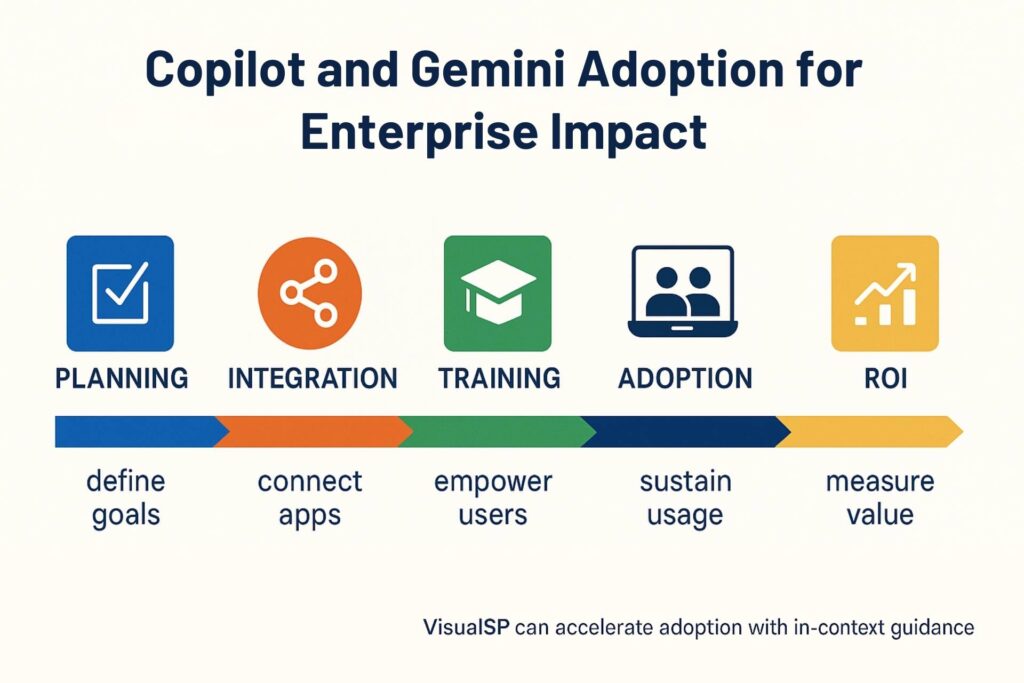
At VisualSP, we work every day to help organizations translate powerful technologies like Microsoft Copilot and Google Gemini into measurable business outcomes. Our platform integrates directly into the web enterprise applications your teams already use, providing in-context support through walkthroughs, inline help, videos, and intelligent prompts. This means your employees can learn and receive guidance without leaving their workflow, which shortens ramp-up time and sustains adoption long after the initial launch.
A major advantage we bring to AI adoption initiatives is our advanced AI-powered content creation engine. It allows administrators and subject matter experts to generate walkthroughs, tip sheets, and micro-training in minutes. Combined with our library of pre-built help assets, this feature enables you to equip users with relevant guidance from the moment they start using tools like Copilot or Gemini. We also provide an AI assistant that delivers real-time contextual help, pre-built prompt templates, and automation for repetitive tasks such as summarizing emails or surfacing key data from CRM systems.
Security and privacy are central to everything we do. VisualSP protects your data and ensures that none of it is used to train AI models. More than two million users worldwide, including organizations such as NHS, VHB, and Visa, rely on us to reduce support costs, increase productivity, and maximize the value of their technology investments.
If you are planning to roll out Microsoft Copilot, Google Gemini, or any other enterprise AI solution, we invite you to see how VisualSP can accelerate adoption and safeguard return on investment. Contact us to schedule a conversation or request a demo, and discover how we can help your workforce adopt AI tools effectively and responsibly.

VisualSP accelerates digital adoption, digital transformation & user training.

Stop Pissing Off Your Software Users! There's a Better Way...
VisualSP makes in-app guidance simple.

