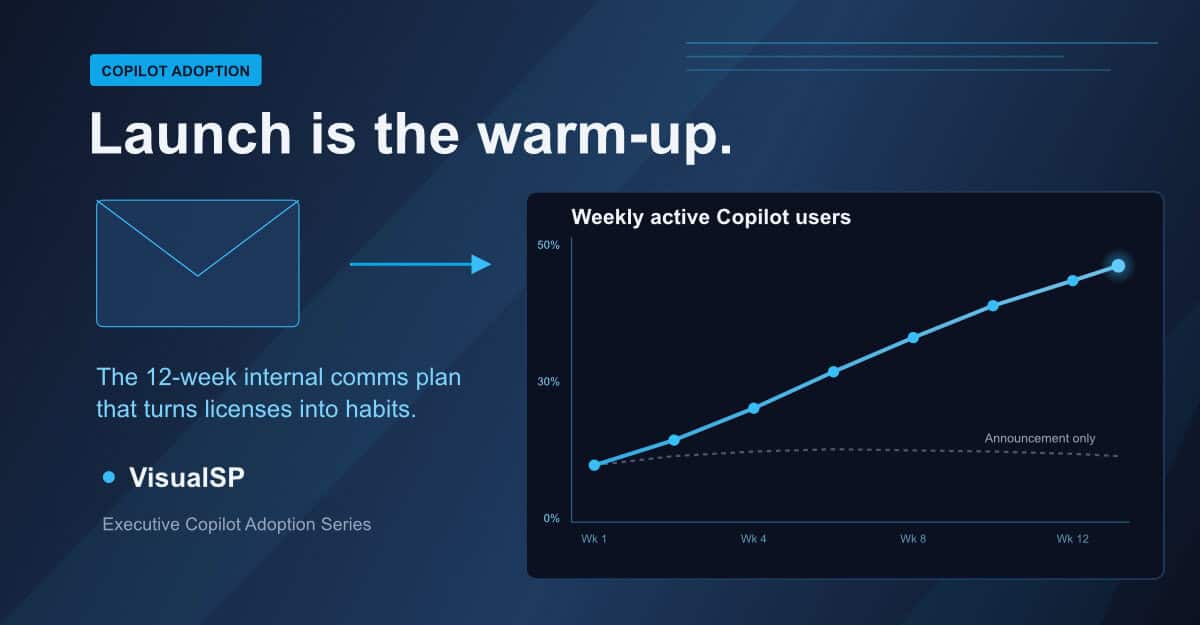
Most mid-size orgs treat their Copilot rollout like a product launch. Slick announcement email, a couple of FAQ pages on the intranet, a launch webinar, then... nothing. Six weeks later the CIO is asking why weekly active usage is stuck at 22%.
The problem isn't the announcement. The problem is that the announcement was the campaign. It was supposed to be the warm-up.
Microsoft's own numbers make the pattern brutal. Roughly 15 million paid Microsoft 365 Copilot seats sold. Only 35–40% of licensed users touch it in a given week. In the mid-market (500–4,999 employees), adoption sits around 31% — the fastest-growing segment, sure, but still two out of every three seats going cold. Your CFO didn't sign the PO so most of the org could ignore it.
If you're the person inside your organization on the hook for making Copilot land, you already know the technology is not the problem. The problem is that you launched a tool where you should have launched a behavior-change campaign. Those are different things. This is the pillar of the executive Copilot adoption plan that gets skipped most often — and it's the one that decides whether the whole program works.
A product announcement runs for one week. A campaign runs for ninety days.
Look at how your marketing team runs a demand-gen campaign. There's a hook. There's cadence. There's a mix of channels. There's a mid-funnel plan for people who saw the first message but didn't act. There's proof — customer stories, screenshots, numbers. There's a "why now" that lives outside the announcement itself.
Now look at how most companies communicate Copilot internally. One kickoff email. Optional training link. A demo that people may or may not attend. Everyone is expected to self-serve from there.
Nobody adopts a new habit from one email. And Copilot isn't a feature — it's a habit. The new muscle memory of stopping mid-task and asking for help. Habits form through repetition and reinforcement. That's what your campaign has to deliver, week over week, for at least a quarter.

If you're building this for a mid-size org, here's the structure that works. Weekly, not one-shot. Specific, not aspirational.
Week 0 — Pre-launch. A short note from a business leader (not IT) explaining why the company is doing this and what changes for the recipient's job. Not features — change. "Meeting recaps are going to happen automatically. Weekly reports will draft themselves. Here's what your Tuesday looks like in six weeks." Skip this if your leader can't speak to a concrete change; a limp executive email is worse than none.
Week 1 — Launch. Access is live. Two things people can try today. That's it. Two. Not fourteen tips. Not a full prompt library. Two prompts they can copy and run before lunch.
Weeks 2 through 12 — Cadence. One email or Teams post per week. Each one shows one real employee doing one real thing. "Sarah in Finance used this prompt to draft the monthly close narrative. Here's the prompt. Here's what came back. Here's what she edited." Steal the shape of Microsoft's own "Great M365 Copilot Journey" weekly emails if you want a template — that pattern works because it's specific and repetitive.
Middle of the campaign — Persona plays. Around week four, split your comms by function. Finance sees Finance examples. Sales sees Sales examples. HR sees HR. Generic "boost your productivity" copy loses. Role-specific examples move usage — every time.
End of the campaign — Proof. Publish the numbers. Weekly active users, hours saved, workflows adopted. If you can't measure it, you didn't run a campaign — you ran a hope.
Every advisor tells you to appoint champions. Fine. But most champion programs die inside a month because the champions have no ammunition.
A champion isn't a volunteer. A champion is a communicator with a job description. Give them one prompt to test each week, one story format to fill out, one place to post it, and one hour of protected time to do it. Without that, "champion" becomes a badge with no work attached and no results to point to.
The organizations getting to 50%+ weekly Copilot usage do three things that hang together: they pick two or three high-frequency use cases and refuse to expand the list; they run mandatory enablement (not optional); and they equip their champions to keep re-selling those use cases every week. Not one of those on its own. All three.
This is the piece nobody wants to hear: a one-shot training day, no matter how good, does not change behavior. It creates awareness. Awareness decays in seven days.
The programs that actually stick — including how we've built Copilot Catalyst at VisualSP — run on a weekly rhythm precisely because that's how habits form. Hands-on activation. Real work between sessions. Asynchronous coaching so a point of friction doesn't kill the momentum. Repetition, application, reinforcement. That's the loop. Your internal comms campaign is the version of that loop everyone in the org sees, whether they're in a formal training cohort or not.
If your Copilot rollout is happening now — or if adoption has stalled and you need to restart — do three things before Friday. Draft the twelve-week internal comms calendar. Actually put it on paper with dates, subjects, and one employee story per week. Identify the two workflows you are going to make everyone learn — not the ten you wish they'd try. Pick your champions and hand them a written role: what you need them to do, how often, and how much time you're giving them to do it.
Then set a check-in for week six. If weekly active usage isn't climbing, the campaign isn't the problem. The specificity of the campaign is the problem. Get more concrete.
Copilot doesn't adopt itself. Your announcement doesn't either. The next twelve weeks of drumbeat is what actually moves the number.
VisualSP accelerates digital adoption, digital transformation & user training.

Stop Pissing Off Your Software Users! There's a Better Way...
VisualSP makes in-app guidance simple.

