Ignite is a week away. Microsoft will roll out another layer of Copilot analytics — new admin reports, deeper tenant visibility, prettier dashboards. A lot of mid-size organizations will walk away from that keynote feeling good about measurement for the first time in two years. That feeling will not survive the next board meeting.
Here's the thing nobody says loudly enough: the Copilot admin dashboard measures activity. Your CFO is measuring value. Those are different problems, and the gap between them is where most Copilot programs quietly stall — not because Copilot doesn't work, but because the people writing the check cannot see what it changed.
This is the sixth installment in our executive Copilot adoption series. We've covered the business case, governance, licensing sequence, personas, change management, and training. This one is about the measurement layer that has to exist on top of what Microsoft gives you — the one almost always missing.
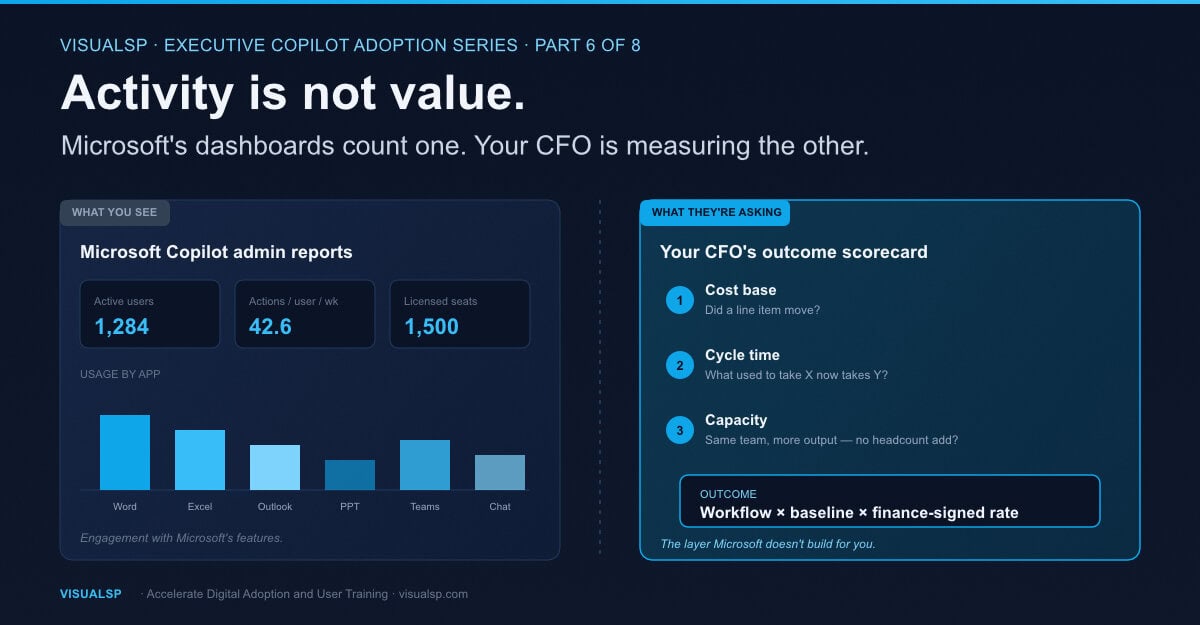
Open the Microsoft 365 Copilot admin center or the Copilot Dashboard inside Viva Insights, and you will see a specific set of numbers: active users, assigned licenses, actions per user per week, feature-level breakdowns across Word, Excel, Outlook, Teams, PowerPoint. If you dig a layer deeper into Copilot Analytics, you can slice by department, tenure, or role. It is more data than any Microsoft product has ever surfaced about user behavior.
None of it answers the question your CFO is going to ask.
What those dashboards measure is engagement with Microsoft's features. That is the only thing Microsoft can see from their side of the tenant. They can see that Priya in finance opened Copilot in Excel 14 times last week. They cannot see whether her month-end close went from eleven days to seven. They can see your sales team drafted 420 emails with Copilot last month. They cannot see whether a single one of those emails closed a deal that would have otherwise died. The platform ends where the business outcome begins.
Forrester put this in writing earlier this year — scale Copilot only where value is, and don't scale without proof. The "proof" they mean is not activity. It's an outcome tied to a workflow tied to a dollar. Nobody at Microsoft is going to produce that for you.

In every budget conversation I've sat through this year, the finance side of the table circles back to the same three questions, roughly in this order.
Has anything in our cost base shifted? Fewer contractor hours, lower vendor spend on a function Copilot now handles internally, shrinking seat counts in a tool Copilot replaces. The CFO wants a line item that moved.
Has anything in our cycle time shifted? Proposals out the door faster. Monthly reports produced in a day instead of a week. Support tickets closing in hours instead of days. Something that used to take X now takes Y, and X minus Y is measurable in time, which converts to money.
Has anything in our capacity shifted? The same team handling more volume, more deals, more cases, more customers — without adding headcount. This is the one that gets Copilot renewed at scale. It is also the one that is hardest to prove because it requires baseline data most organizations never captured.
Notice what is missing from that list: anything that looks like a Microsoft dashboard metric. The CFO does not care how many prompts your team typed. The CFO cares whether anything that costs money got cheaper, faster, or more productive. If you walk into a renewal review with an activity report and no outcome story, the finance team will do the math themselves — and their math is simpler than yours.
The outcome layer sits on top of what Microsoft gives you and has three pieces, in this order.
First, pre-rollout baselines on a specific workflow. Not "productivity in finance." Not "efficiency in marketing." A specific workflow — month-end variance commentary, inbound RFP response, QBR deck assembly — with a baseline measurement captured before Copilot touches it: time per cycle, people involved, output volume, defect or rework rate. Most Copilot programs skip this step because it's annoying, and then spend the next twelve months unable to prove anything.
Second, workflow-level tracking after rollout, on the same measures, on the same workflow, by the same team. You are not trying to measure "Copilot's impact on the company." You are trying to measure Copilot's impact on this specific thing, over this specific period, done by these specific people. Three workflows done this way beats twelve organization-wide dashboards every time.
Third, a finance-signed conversion rate. Hours saved become dollars saved only if finance agrees to the fully-loaded hourly rate you are multiplying by. Cycle-time reductions become capacity gains only if finance agrees that the recovered capacity went somewhere revenue-producing instead of into longer lunches. Get this agreed in advance, in writing, with the CFO's team — before you report any numbers. Numbers you reported first and asked finance to validate later get discounted to zero.
Do that for three to five workflows across your highest-leverage personas and you have a Copilot ROI story that survives a CFO meeting. Skip it and you have an activity report nobody above the IT director will read.
Pick one workflow in one department that your Copilot program claims to improve. Walk down the hall to the person who actually owns it — not the Copilot champion, the real operational owner — and ask them two questions: how do you measure success on this today, and how much of that measurement do you have in writing. If the answer is "we don't really measure it," you've found your first outcome gap. Fix that one before you worry about scaling.
The organizations still funding Copilot a year from now are not the ones with the highest usage numbers. They're the ones who sat down with finance in month three, defined what outcome means in dollar terms, and have been measuring that one thing ever since. Microsoft will keep improving the activity layer — that's their job. The outcome layer is yours, and it's the only thing standing between your program and the quiet renewal cut that happens when a CFO can't tell what they bought.
VisualSP accelerates digital adoption, digital transformation & user training.

Stop Pissing Off Your Software Users! There's a Better Way...
VisualSP makes in-app guidance simple.

