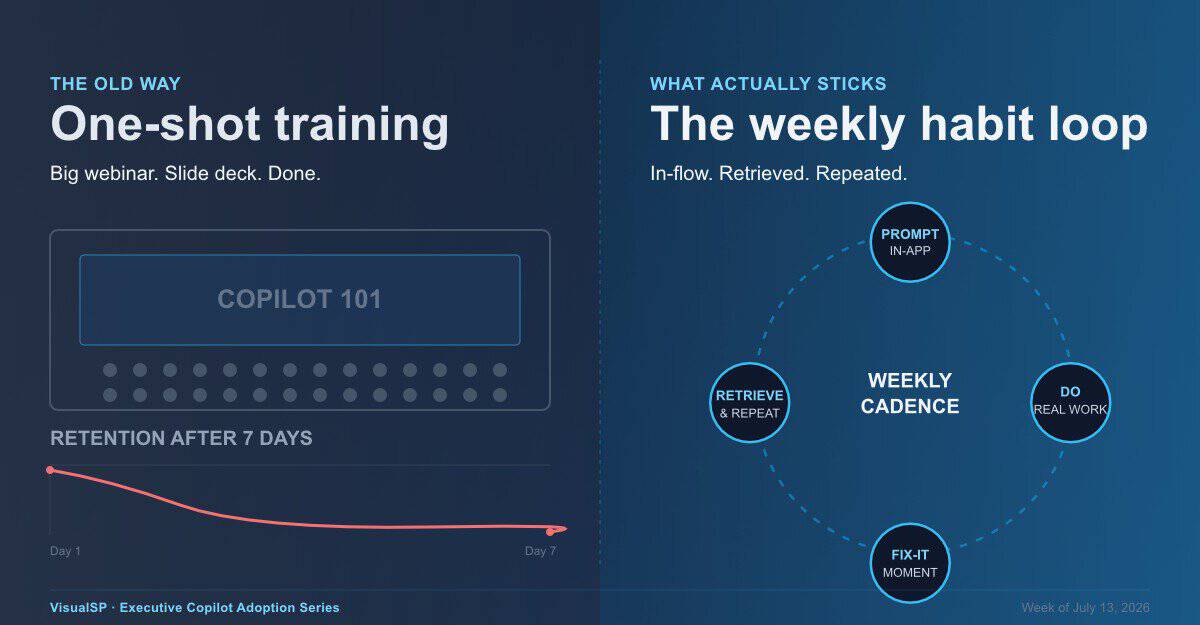
Every Copilot rollout I see in the mid-market has the same photo in the deck: a full conference room, a projector, someone from IT walking through prompts. It's called "Copilot Enablement Day." Everyone gets a lanyard. HR sends a very nice thank-you email. Six weeks later, weekly active usage is stuck under 30%.
The training didn't fail because the trainer was bad. It failed because standalone training almost never changes behavior in a knowledge-work environment. And Copilot, more than any tool your organization has bought in the last decade, requires a behavior change to pay off.
This is the pillar of the executive Copilot adoption plan where good intentions go to die. If you're on the hook for making Copilot land inside your organization, this is probably the part of the plan you inherited half-built. Let's talk about what to actually build in its place.
Ebbinghaus figured this out in 1885. Within 24 hours of a one-shot training, people lose more than half of what they learned. Within a week, most of the rest is gone. Corporate L&D has known this for a century. Somehow every Copilot rollout still starts with a 90-minute webinar and a PDF of prompts, then acts surprised when adoption flatlines.
McKinsey's number on this is the one worth showing your executive sponsor: only about one in three organizations offers structured generative AI training, even though 48% of leaders admit it's essential for adoption. And the users themselves keep telling us the same thing — roughly 62% cite "not enough time to learn" as their biggest blocker. They're not saying training was bad. They're saying training that requires pulling them out of their workflow is the wrong shape.
Microsoft's own Copilot deployment guidance changed in the last twelve months precisely because they saw this. Their new Learning Agent — the one that just went generally available inside Microsoft 365 Copilot — is a bet on personalized, in-the-flow learning powered by Work IQ. That's Microsoft admitting that classroom training doesn't move the needle. If they're saying it, your rollout plan should reflect it.

In-flow learning means the help shows up inside the app the user is already in, at the moment they need it, tuned to the task they're actually doing. Not a separate tab. Not a portal. Not "please review the Copilot fundamentals course by Friday." It's a walkthrough that fires when someone opens Copilot in Word for the first time. It's a prompt scaffold in Excel when they're staring at a blank cell. It's a mini-lab that runs in three minutes when they're between meetings.
This is what a real Copilot enablement stack looks like in a mid-size org in 2026:
This is exactly why we built Copilot Catalyst at VisualSP the way we did — the digital adoption layer sits inside Copilot and Microsoft 365, so the training and the tool are the same experience. There's no calendar invite. The lesson happens in the workflow. That's the shift.
Habits form through repetition and retrieval, not exposure. If you want Copilot to become how someone works, they have to do it, get feedback, do it again, and get it right — every week, for at least a quarter, on real work they actually own.
Here's the loop that works. Every week, pick one workflow. Not five. One. "This week, we're all writing our status updates in Copilot." Provide the prompt. Provide a two-minute in-app walkthrough. Provide a one-question retrieval check on Friday. Publish who did it and what they saved. Next week, same shape, next workflow.
That's not a training program. That's a habit engine. It looks boring on paper. It is the single strongest predictor of whether Copilot usage climbs or stalls in month three.
Microsoft's Copilot Adoption Playbook talks about this using words like "champions" and "communities of practice." Fine — those are useful. But the operating principle underneath is the same: repetition on real work, tightly coupled to feedback, embedded in the flow. Everything else is theater.
If your Copilot program is either about to launch or stuck, do three things before Friday.
First, kill the standalone Copilot training day if one is still on your calendar for this quarter. Redirect the budget and the calendar time toward in-app enablement — a digital adoption layer, a per-persona prompt library that surfaces contextually, and a bank of five-minute micro-labs. If you can't get all three, get the first one. That's the wedge.
Second, pick the two workflows you are going to make sticky first. Meeting recaps and weekly status updates are the two that work in almost every org because they are high-frequency, low-risk, and immediately time-saving. Everyone gets a win in the first month. Do not let anyone talk you into starting with something exotic.
Third, put a retrieval mechanism on the calendar. A weekly two-minute in-flow check. A monthly "show me what you did with Copilot this month" one-hour session per team. Something. Because the training that isn't retrieved is the training that decays. Forrester's TEI work modeled 106–314% ROI on Copilot when structured training and reinforcement were built in. That range isn't a fluke — it's the difference between habit and hope.
The organizations getting to sustained 50%+ weekly Copilot usage aren't the ones with the best trainer. They're the ones who accepted early that "training" wasn't the deliverable. The habit was. Build for the habit and adoption follows. Build for the training day and you'll be explaining the flat usage chart to your CFO by October.
VisualSP accelerates digital adoption, digital transformation & user training.

Stop Pissing Off Your Software Users! There's a Better Way...
VisualSP makes in-app guidance simple.

